Dear Neighbor,
The House was in session and I was in Washington this week. Here is the report: |
Trump Slush Fund. Everyone in Washington this week was talking about the announcement of a $1.8 billion fund for President Trump’s allies. How did we get here? In January, President Trump, his eldest sons, and the Trump Organization sued the Internal Revenue Service (IRS) and Treasury Department for $10 billion over the leak of President Trump’s private tax returns during his first term (a leak not limited to him and for which the person responsible has already been convicted and sentenced). The court hearing the case questioned whether the two sides were genuinely adverse, given that Trump controls the agencies he's suing. The court got briefing from outside experts that there was not. Rumors started circulating at the end of last week that were confirmed on Monday when the President dismissed his case against IRS and announced that, as a “settlement” of the case, the Department of Justice would draw from the Treasury's Judgment Fund, a taxpayer-funded account for settled government claims, to compensate individuals who claim they were targeted by the Biden administration. Eligible recipients could include Trump political allies, Trump-affiliated entities, lawmakers, and the nearly 1,600 defendants charged in connection with January 6. Trump is to control a five-member commission with authority to approve awards, retain power to fire members without cause, and keep the identities of the people who receive the funds confidential—keeping the public in the dark about who gets paid or how much. The brazen corruption here is staggering, and it had an impact on the week in Washington. I introduced a bill yesterday to stop it from happening, now or in the future. More on this in Legislation and Letters below.
EPA Rolls Back Drinking Water Protections. Also in the news this week, the Environmental Protection Agency (EPA) announced a plan to rescind partially the first national drinking water limits for per- and polyfluoroalkyl substances (PFAS), also known as forever chemicals, set during the Biden Administration. The EPA plans to eliminate strict limits for PFAS and allow utilities to request a two-year extension to remove two other PFAS from tap water. The Safe Drinking Water Act bars the EPA from amending existing regulations to reduce protections for public health, so this will not go unchallenged and is not the end of the story. |
This week in the House took a few turns. At the beginning of the week, we expected the House to consider President Trump’s request for a second budget reconciliation bill to allocate $70 billion in federal funding for U.S. Immigration and Customs Enforcement (ICE) and Customs and Border Patrol (CBP) and $1 billion for President Trump’s White House ballroom. The bill would start in the Senate and come to the House by the end of the week. But we left Washington without considering the bill because the Senate never passed it. They left town on Thursday without a bill, in part because of much-needed pushback on the President’s billion-dollar ballroom (which he said we would be privately funded) and the President’s nearly two billion dollar slush fund.
We also expected to vote on another war powers resolution (H.Con.Res.86) to end the war with Iran without congressional authorization for the use of force. This war started more than 85 days ago, yet the President has neither come before Congress to make the case for war—as the Constitution requires—nor has he presented evidence of an imminent threat to the United States. When a member of either party introduces a privileged resolution in the House, the House is required to vote on it within three voting days. The House was scheduled a vote on this resolution Thursday afternoon, but Republican leaders canceled the vote while we were on the House floor ready to vote, apparently because it was going to pass. They also canceled votes on Friday, so it will be considered when the House reconvenes the week after next.
We did vote on a few controversial bills, however. On Wednesday, the House considered the disingenuously named Stopping Indoctrination and Protecting Kids Act (H.R. 2616), a bill to require public elementary and middle schools that receive federal funds to obtain parental consent before changing a student’s preferred name on any school form or adjusting sex-based accommodations. The bill contains no exceptions, even requiring parental consent for teachers to add a student’s nickname to school forms, creating additional paperwork and needless burdens on teachers’ and administrators’ time. This is neither helpful, necessary, nor the role of Congress. Members of Congress are not better positioned than parents and teachers to make personal and complex decisions that could put vulnerable kids at risk. I voted against this bill, which passed 217-198.
On Thursday, the House considered the Smithsonian American Women’s History Museum Act, H.R. 1329, to secure a site for the American Women’s History Museum on the National Mall. This legislation has been a years-long bipartisan effort to secure an American women’s museum, and I am a cosponsor of the original bill. Since its introduction, however, the House Committee on Administration amended the bill to give unprecedented and undue control over the museum to President Trump and to include other poison pills. I joined 146 members of the Democratic Women’s Caucus in a letter to Speaker Mike Johnson urging him to restore the longstanding, bipartisan version of this bill. He failed to do so, and so I joined all House Democratic women (and all Democrats and six Republicans) and voted against this version bill, which failed to pass the House by a vote of 204-216.
The House considered two veterans bills: (1) the Veterans 2nd Amendment Protection Act (H.R. 1041), a bill to make permanent harmful provisions first enacted in the Fiscal Year 2024 Consolidated Appropriations Act (H.R.4366)—stripping hundreds of thousands of records from the National Instant Criminal Background Check System (NICS) and blocking the Department of Veterans Affairs (VA) from reporting beneficiaries deemed mentally incompetent and assigned a fiduciary to NICS. This policy has undermined the VA’s ability to keep vulnerable veterans safe and has put them at greater risk of harm and (2) the Sharri Briley and Eric Edmundson Veterans Benefits Expansion Act of 2026 (H.R.6047), a bill to increase disability compensation for severely injured veterans and survivors of veterans with service-connected disabilities by raising home loan and refinancing fees for servicemembers and veterans—making it harder for veterans to refinance their VA home loans and putting them at greater risk of losing their homes. For these reasons, I voted against both bills, which passed the House 216-201 and 235-179, respectively.
The House also considered several bills under suspension of the rules, including the 21st Century ROAD to Housing Act (H.R. 6644), a bipartisan legislative package to address the nationwide housing supply shortage. The House also passed several bills aimed at regulating the financial services industry, including the Keeping Deposits Local Act of 2025 (H.R. 3234), the American Access to Banking Act (H.R. 4544), and Community Bank Deposit Access Act of 2025 (H.R. 5317). The House also passed a bill to mint and issue coins to commemorate the 25th anniversary of the September 11, 2001 attacks (H.R. 1993) and Lulu’s Law (S. 1003), a bill to permit the transmission of wireless emergency alerts to mobile phones in the event of a shark attack.
As a reminder, you can always find a list of all of the votes I have taken for the district on my website. |
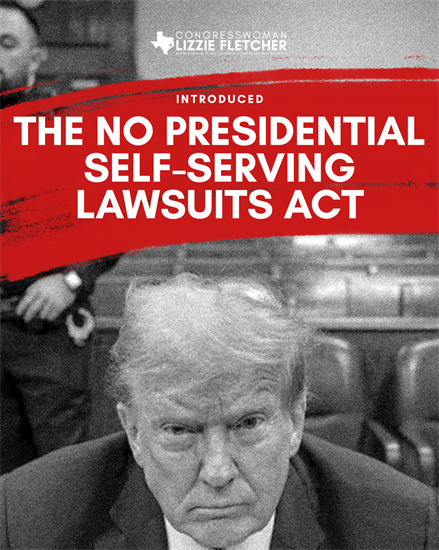
This week, in response to the announcement of President Trump’s purported settlement with the United States government creating a slush fund for him to pay his political allies, I introduced the No Presidential Self-Serving Lawsuits Act to bar any president from initiating civil lawsuits against the U.S. government while in office and to prohibit use of the Treasury’s Judgment Fund to settle civil claims arising out of such a case. |
President Trump’s $10 billion lawsuit and unvetted “settlement” agreement with a government department acting at his behest is a perversion of our system of justice. Most of us could not have imagined that such a “settlement” could occur, or that there are not more clear and obvious prohibitions to this outcome. But here we are: the President of the United States brought a lawsuit against the United States, appointed his personal attorney to the Department of Justice, and then ‘settled’ with the United States by creating a nearly $2 billion slush fund of our tax money to hand out to his supporters, including those who stormed the Capitol on January 6, without oversight, disclosure or guardrails.
The corruption and abuse is staggering, even for this administration. The No Presidential Self-Serving Lawsuits Act ensures that no president can use the power of the office to turn the courts and the Treasury into a personal rewards program for their political allies. I was glad to lead the effort on this bill with the support of 26 original co-sponsors and endorsing organizations, including Lawyers for Good Government and Public Citizen. It’s hard to believe we have to do this, but we do.
On Monday, I joined 92 of my Democratic colleagues in filing an amicus brief on a motion to block this settlement in court. The brief argues that the lawsuit is feigned and collusive, that President Trump is on both sides of the case, and that the lawsuit suffers from fatal defects that the DOJ failed to raise.
Also this week, I joined my colleagues in sending a letter to the Bureau of Alcohol, Tobacco, Firearms and Explosives (ATF) Director Robert Cekada and Acting U.S. Attorney General Todd Blanche urging the Department of Justice and the ATF to reconsider 34 new sweeping regulatory changes that will weaken oversight of the firearms industry and hinder law enforcement's ability to combat gun violence.
I also cosponsored the FEMA Act of 2025, H.R. 4669, to reestablish the Federal Emergency Management Agency (FEMA) as an independent, cabinet level agency, and to reform Federal disaster mitigation, preparedness, response, and recovery. |
On Wednesday, the Energy & Commerce Committee’s Subcommittee on Health held a hearing on Medicare physician payment reform. I know how important this issue is to the many physicians that live in Texas’ Seventh Congressional District. I used my time to highlight the need to stabilize the Medicare Physician Fee Schedule in the long term and the importance of adding an update to Medicare physician payments to adjust them automatically for inflation. You can watch my full remarks below. |
On Thursday, the Energy & Commerce Committee held a full committee markup on 16 bipartisan bills.
Fourteen of the bills came from the Health Subcommittee to protect the health of the American people. The legislation we are considering reauthorizes and strengthens work around prevention and early detection and sustained federal research and infrastructure, including the “ACT for ALS Act,” which extends programs at the Food and Drug Administration (FDA) and the National Institutes of Health (NIH) to accelerate research and promising therapies for ALS, and the NIH IMPROVE Act (H.R. 6238) provides funding for important research on maternal care and mortality. During the markup, I spoke on the importance of working to improve health outcomes for pregnant women and to address the maternal mortality crisis. I also used my time to highlight that for the past year, the Trump administration has worked to decimate essential women’s health programs and has cut funding for NIH research grants. While this bill is important and I was glad to vote in favor of it, we must protect other essential programs that are under attack from the Trump administration. You can watch my remarks on that below. |
We also passed a bipartisan recycling bill from our Environment Subcommittee that is an important step in bolstering our domestic recycling and composting systems through improved data collection and increased recycling accessibility. And we passed a bipartisan safety bill, which will be included in the larger Surface Transportation bill, to enhance safety on our roadways both for vehicle occupants and for vulnerable road users, such as bicyclists. Within that bill, the committee also included a provision to make Daylight Savings Time permanent and end the practice of changing our clocks twice a year. I’m not sure why it was part of that package, but I know people across the district have strong feelings on the issue. We’ve gotten lots of calls over the years, and I’ve surveyed readers of this weekly email. About 82 percent of people responding said they want to stop changing the clocks twice a year, 15 percent want to keep things as they are, and 3 percent are unsure.
I voted in favor of all sixteen bills, which all passed the committee with strong support. |
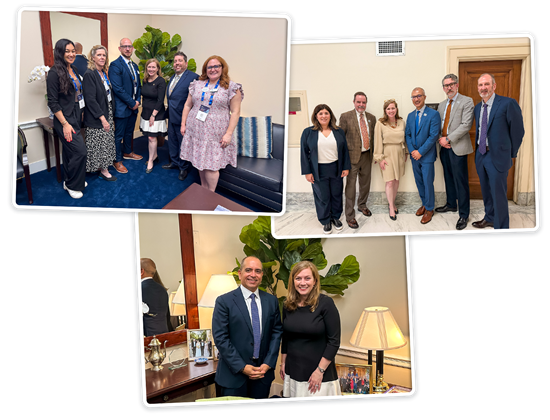
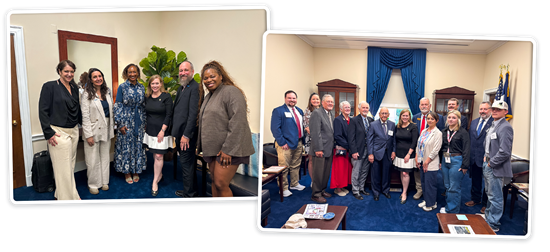
This week, I was glad to have time to visit with representatives from the Jewish Federation of Greater Houston, Harris Health, and Comcast. |
I was also glad to meet with fellow Texans this week, including representatives from the American Civil Liberties Union (ACLU) of Texas (led by Houstonians!) and the Texas Farm Bureau (including some friends from Fort Bend County). |
In Washington, Team TX-07 held more than two dozen meetings with constituents and groups advocating on their behalf, including Foreign Policy for America, Texas Society of Anesthesiologists, and the Port of Houston, pictured below. Back home in the district, our team was out and about across the district, helping constituents and attending community events, including the Greater Houston LGBTQ+ Chamber of Commerce's Community & Connections Breakfast, the Southwest Management District's Morning Mixer, the Fort Bend Regional Partnership's Principal Appreciation Reception, and a meeting in our district office with Book Harvest, pictured below. |
Save the Date! Next Saturday, May 30, 2026, our team will host another passport fair for (1) first-time passport or passport card applicants and (2) renewal and replacement passports or passport cards at Burnett Bayland. Representatives from the Houston Passport Agency will be present to answer questions and accept applications. Please RSVP here or by clicking the image below. |
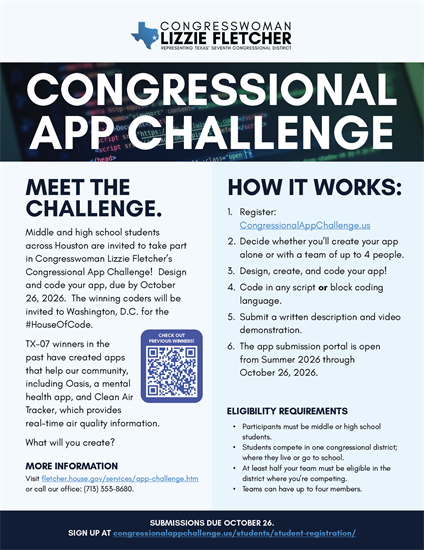
TX-07 middle and high school students looking for something to do this summer can come up with an app idea and submit it to the Congressional App Challenge. Learn more about the competition by clicking here or on the graphic below. Submissions are due October 26, 2026. |
The House will not be in session next week. I am looking forward to spending some time back home in the district.
Monday is Memorial Day, a day to remember the Americans who have died while serving in the United States Armed Forces, making the ultimate sacrifice for our country's highest ideals: our rights, our freedoms, and our democracy. We should remember and honor them every day by continuing their defense of these ideals and our fellow Americans. |
Our offices will be closed on Monday to observe the Memorial Day holiday. We will be back in the office and out and about in the district on Tuesday, so don’t hesitate to call the office at (713) 353-8680 or (202) 225-2571 (or email here at any time) to ask for assistance or share your thoughts.
As always, I am proud to represent you and I am here to help you. I look forward to hearing from you.
Best wishes, |
|