Dear Neighbor,
The House returned to Washington this week following, and so did I. Here is my report on the week’s events and more. |
It was the House’s first week back since late July, so people were talking about a lot of things in Washington this week. But with the the mid-term elections (and the end of this Congress) getting closer, much of the focus was on this week’s reporting about a complaint from a whistleblower at the United States Postal Service (USPS). You may remember that in May, President Trump issued an Executive Order directing the Postal Service to establish new procedures for mail-in ballots in an attempt to restrict mail-in voting ahead of this year’s election. In response, the USPS recently published a final rule that imposes restrictions on mail-in ballots. This rule requires specific envelope design and ballot tracking capabilities, and requires states to develop and provide the USPS with state mail-in and absentee participation lists containing personal information about registered voters. Any state that does not turn over this sensitive voter data to the Trump administration will not have its ballots delivered.
In response to this rule, multiple states sued the Trump administration, presenting several challenges to this order and rule, including, of course, that the states and Congress have the power to regulate federal elections, not the executive branch and not the postal service. The case is proceeding in the courts.
This week, a USPS whistleblower reported that the USPS is still rushing to implement this new system to track mail-in ballots, despite the pending legal challenge. This whistleblower also raised the alarm that officials are developing the system in a “risky and haphazard” way and warned that it could fail, and cause thousands of mail-in ballots to go uncounted. There has been a lot of public reporting on this, and I encourage you to learn more. It is pretty shocking, and very dangerous. |
First on the agenda this week was House consideration of a resolution the Senate passed this summer to continue funding the government at the current funding levels until December 11, 2026 (a continuing resolution). The Continuing Appropriations and Extensions Act, 2027 (H.R. 6500), passed by a vote of 370-48, and I voted in favor of it. It is important to note that this extension does several important things: it does not provide any new funding to Immigration and Customs Enforcement (ICE), prevents the Department of Homeland Security (DHS) from transferring funds to ICE and Customs and Border Patrol (CBP), and delays the implementation of a proposed Office of Management and Budget (OMB) rule that gives political appointees the authority over federal grants.
For the rest of the week, the House mostly considered divisive and overly political resolutions and bills, among them a resolution “providing for the condemnation and denouncement of socialism in all its forms” (H.Res. 1490). I voted against it. This resolution was a partisan stunt rather than any serious effort at governing. But, as my friend and colleague Jamie Raskin explained during debate of a similar bill earlier this Congress, many of our strongest democratic allies, including Norway, Sweden, Denmark, Iceland, and Finland, lead strong democratic socialist governments and thriving societies and economies, but the resolution advances a false equation between democratic socialism and Communist dictatorships. It equates the great programmatic achievements of American democracy as ‘socialist,’ including Medicare, Medicaid, Social Security, public education, public health measures and the Affordable Care Act. As Rep. Raskin explained more eloquently and succinctly than I can, “by defining essential democratic public programs as ‘socialist’ and claiming that socialism inevitably leads to Stalinist communism and societal collapse, these plutocrat Republicans are plainly working to undermine the living standards of the American majority and rip up the social fabric of the nation.” This anti-socialism resolution also calls for the enactment of the so-called “SAVE America Act,” the bill the President and Congressional Republicans are claiming protects our elections when it really does the opposite. In any event, I voted against this resolution, but it passed 220-192.
The House also considered a resolution proposing a constitutional amendment to require that the Supreme Court of the United States be composed of nine justices (H.J.Res. 1). The Constitution specifically grants Congress the ability to determine the number of justices on the Supreme Court, and Congress has used its power several times in our history to change the Supreme Court’s composition. In the nineteenth century, Congress started at six justices and reached up to 10 justices during the Civil War, before an 1869 law created the modern nine-person bench. I do not support removing Congress’ constitutional right to determine the appropriate number of justices, among other things, and I voted against it. This resolution needed a two-thirds majority to pass, but its final vote of 212-206 failed.
The House also considered the Northeast Lobsterman Protection Act of 2026 (H.R. 9436) to extend a six-year waiver of Endangered Species Act (ESA) and Marine Mammal Protection Act (MMPA), which I voted against, and the Protecting Domestic Mining Act (H.R. 1501), which would codify in law a fast-track approval process for mining projects, which I also voted against because the process was intended for high priority projects of national significance but this bill makes the process available to a wide variety of mining activity and limits the ability of future administrations to prioritize certain sectors in the future.
On Thursday, the House considered the Protect Economic and Academic Freedom Act (H.R. 4795), which prohibits colleges and universities that receive Title IV federal student aid programs from participating in “non-expressive commercial boycotts” against the State of Israel. I agree that we must disavow and respond to rising hate and antisemitism, and we must support students and help ensure their security on campuses across the country, and I know that the very real challenges on college campuses are concerning to many in our community, but this bill raises constitutional and compliance concerns without protecting students. Instead, its requirements would penalize colleges and universities that engage in constitutionally protected boycotts and condition funding on policies that implicate First Amendment-protected speech, and could even collectively impact federal student aid for students who have not engaged with boycott efforts themselves. As we have seen, the Trump administration has not hesitated to find new ways to revoke federal funding in many contexts, and this bill would set a dangerous precedent in codifying such behavior into law, at the cost of students’ civil rights and liberties. Furthermore, this bill does not address an ongoing or existing higher education policy of boycotting Israel. Instead, it creates new federal requirements intended to prevent colleges and universities from adopting such policies in the future. This bill would threaten to stifle freedom of speech and violate First Amendment protections and is not the right vehicle to protect our students and campuses. For these reasons, I voted against the bill, which passed the House by a vote of 237-169.
The House also considered several bills under suspension of the rules, all of which passed, including a bill to deliver stronger, lifelong protection to survivors of federal sex crimes, Kayleigh’s Law Act of 2026 (H.R. 8481). And the House also voted to censure Representative Chuck Edwards (H.Res. 1498) based on the findings of the House Committee on Ethics by a vote of 413-2.
As a reminder, you can always find a list of all of the votes I have taken for the district on my website. |
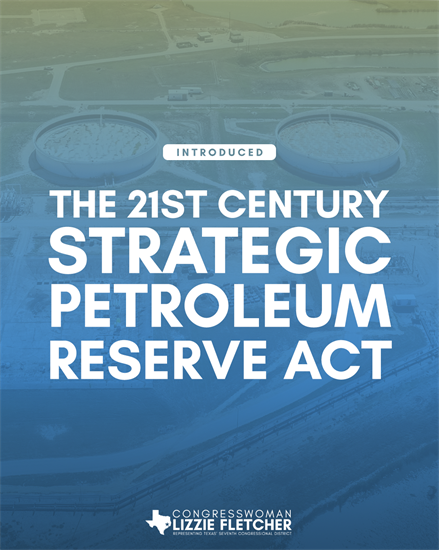
On Thursday, I introduced the 21st Century Strategic Petroleum Reserve Act (21st Century SPR Act) with Congressman August Pfluger (TX-11) to direct the U.S. Department of Energy to issue a public report on opportunities to modernize the U.S. Strategic Petroleum Reserve (SPR). |
Congress created the SPR after the 1973 Arab oil embargo to protect American consumers and the economy from sudden supply shocks. The reserve stores crude oil in underground salt caverns in Texas and Louisiana, giving the federal government a tool to stabilize prices when global oil supplies are disrupted. It has, however, faced real strain in recent years. Russia's invasion of Ukraine triggered a 180-million-barrel emergency release in 2022, and the ongoing war in Iran—including the closure of the Strait of Hormuz, which has disrupted roughly one-fifth of the world's oil supply—has driven a second major drawdown. The reserve now sits at its lowest level since the early 1980s, at under half of its total capacity. A recent U.S. Government Accountability Office report found that Congress and the Department of Energy still lack a unified long-term plan for the SPR, including a target size for the reserve and a clear strategy for maintaining its aging infrastructure. Meanwhile, other countries have moved to build up their own reserves. China, which is not a member of the International Energy Agency and does not publicly disclose its inventory, holds an estimated 1.4 billion barrels of oil in strategic reserves—more than four times the current U.S. stockpile, according to the U.S. Energy Information Administration. If enacted, the 21st Century SPR Act would require the Secretary of Energy, within 90 days of enactment, to request that the National Petroleum Council—an advisory committee to the Secretary—deliver a public report within one year analyzing opportunities to improve and modernize the SPR's physical infrastructure and operations to respond to supply shocks like the 2026 closure of the Strait of Hormuz. The bill also directs the National Petroleum Council to make recommendations to Congress and federal agencies on modernizing the SPR going forward.
I also joined my colleagues in co-sponsoring several other pieces of legislation of importance to our community, including: - the Raise the Wage Act of 2025, H.R. 2743, to provide for increases in the Federal minimum wage;
- the Stop Ballroom Bribery, H.R. 6085, to prevent corruption by appropriately limiting donations for any public property, building, or fixture at the White House, the Naval Observatory, or certain other public property, for events on such property, or for monuments to living current or former Presidents, current or former Vice Presidents, or current or former employees or officers appointed by the President;
- the TPS Review Act, H.R. 9944, to reinstitute judicial review for Temporary Protected Status (TPS) terminations, establish a cause of action for TPS recipients and their representatives to sue for relief in court, and allow Congress to reverse a TPS termination under the Congressional Review Act.
- the Upholding Protections for Unaccompanied Children Act of 2025, H.R. 6389, to amend the “One Big Beautiful Bill Act” to repeal or amend certain provisions that undermine protections and heighten dangers for unaccompanied children;
- the WIC Benefits Protection Act, H.R. 5740, to amend the Child Nutrition Act of 1966 to require mandatory funding for the Special Supplemental Nutrition Program for Women, Infants, and Children (WIC);
- the Department of Homeland Security Officer for Civil Rights and Civil Liberties Act, H.R. 2901, to amend the Homeland Security Act of 2002 to make certain improvements to the DHS Officer for Civil Rights and Civil Liberties;
- the Stop ICE from Kidnapping U.S. Citizens Act, H.R. 4456, to block federal funds to ICE that are being used for civil immigration enforcement activities to detain or transport U.S. citizens outside the United States;
- the Reproductive Data Privacy and Protection Act, H.R. 3218, to amend title 18, United States Code, to ensure requests for data on individuals do not pertain to reproductive services;
- the Access to Reproductive Care for Servicemembers Act, H.R. 1742, to establish leave policies of the Armed Forces for a member to seek an abortion;
- the Follow the Science Act, H.R. 7173, to amend the Public Health Service Act to ensure scientific integrity in the activities of the National Institutes of Health and prevent the diversion of funds to politically driven activities;
- the Banning Antiquated Duties and Delivering Equitable American Levies (BAD DEAL) Act of 2026, H.R. 10175, to repeal Section 338 of the Tariff Act of 1930 and provide refunds for all tariffs paid under this authority; and
- a resolution expressing the sense of the House of Representatives that over 25 years of real-world evidence and hundreds of peer-reviewed studies proving that mifepristone is safe and effective should be respected, and law and policy governing access to lifesaving, time-sensitive medication abortion care in the United States should be equitable, transparent, and based on the best available peer-reviewed evidence-based science, H.Res. 1285.
I joined my colleagues in sending several letters this week, too, including: - a letter to President Donald Trump urging the Trump Administration to change course in its approach to Canada and recognize Canada as a close friend, ally, neighbor, and economic partner;
- a letter demanding the release of the remaining $3.5 billion of Fiscal Year 2025 funding in the Global Health Programs account and opposing the proposed plans to change the structure of the President's Emergency Plan for AIDS Relief (PEPFAR); and
- a letter to Secretary of Homeland Security Markwayne Mullin, Federal Emergency Management Agency (FEMA) Administrator Cameron Hamilton, and FEMA Review Councilmember Patrick Powers providing recommendations on FEMA’s Review Council Report and specifically on “Key Recommendation 7 — Reform the National Flood Insurance Program (NFIP) for Financial Stability and Risk Resilience.”
|
On Wednesday, the Energy & Commerce Committee held a full committee markup of 10 bills on energy and environmental issues. Eight of these bills focused on nuclear energy deployment, reducing diesel emissions, and battery recycling passed the committee unanimously, with my support. The two remaining bills targeted California’s emissions standards for locomotives and New York City’s standards for bus idling. I voted against both of these bills, which overturned policies enacted at the local level to address health concerns in specific areas in favor of federal, less stringent emissions standards. |
Since I last wrote you but before I returned to Washington this week, I was honored to join leaders from across our community as an honored guest at the Indo-American Chamber of Commerce of Greater Houston's Annual Gala. Since its founding in 1999, IACCGH has fostered engagement and collaboration between people across our community with people in India and beyond. I was glad to see so many TX-07 residents there, as well as leaders from other local chambers of commerce, including the Texas-Africa Chamber and the Asian American Chamber. |
In Washington, Team TX-07 held 18 meetings this week with constituents and groups advocating on their behalf, including the Houston Forensic Science Center, Breakthrough Type 1 Diabetes Advocates, Land & Legacy Project at the Thurgood Marshall School of Law, and Clean Energy Buyers Association. Back home in the district, our team hosted another successful constituent services pop-up at the Alief Neighborhood Center and attended lots of community meetings and events, including with the American Association of Kidney Patients, the Parris Foundation, the American Physical Society, and Good Works Collective, the Sugar Land Space Cowboys game with Mayor Carol McCutcheon and Council Member Rob Boettcher, the Greater Houston Business Procurement Forum's Monthly Breakfast, the Greater Heights Area Chamber of Commerce's Business & Breakfast with Controller Chris Hollins, Alief ISD’s The Young Women’s Leadership School Ribbon Cutting, the University of Houston’s Civic Houston Internship Program (CHIP) Orientation, the Greater Heights Area Chamber of Commerce's Lunch and Learn, the Diana Foundation’s Foundation First Wednesday Happy Hour, a visit to GiGi’s Playhouse Houston, ribbon cuttings for the Fort Bend County JP 3-1 Free Legal Kiosk and Asia's House, and a neighborhood meeting in Alief, pictured below. |
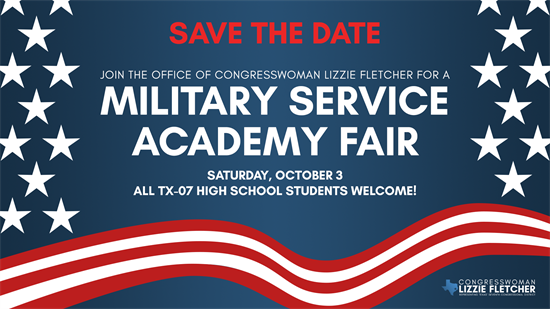
Save the date! On Saturday, October 3, I will host this year’s Military Service Academy Fair for students across the district to learn more about the nomination and application process and visit with representatives from our nation’s service academies. |
The House has recessed until Monday, September 14. On Monday, we will observe Labor Day, honoring and celebrating American Workers. American workers are the backbone of this country, wearing all kinds of hats and wielding all kinds of tools, whether a hard hat, a ranger hat, a stethoscope, a hammer, or a pencil. I am proud to represent so many hard-working people who do so much and to celebrate them on Labor Day. |
As always, I am proud to represent you and I am here to help you. Please call my office at (713) 353-8680 or (202) 225-2571 or email here at any time to ask for assistance or share your thoughts. I look forward to hearing from you.
Best wishes, |
|