Dear Neighbor, It was a full and chaotic week in Washington, and I’m glad to provide this week’s report on the work in Congress.
|
Shooting at the White House Correspondents Dinner. On Saturday, members of the press and elected officials gathered in Washington, D.C. for the annual White House Correspondents’ Association dinner. Early on in the dinner, an armed gunman attempted to enter the ballroom at the Washington Hilton Hotel where the event takes place every year, but law enforcement acted swiftly to stop him and protect everyone in attendance–including President Trump, cabinet officials, members of the House and Senate, and journalists. I am grateful for that swift action.
Political violence is never the answer. And we must continue to fight to make our communities safer from gun violence wherever it occurs and safe for discourse and deliberation that do not begin or end with violence. That’s the idea of democracy. A new White House ballroom isn’t the answer, either, as some claimed, and a few lawmakers even suggested funding this week. A White House ballroom would not address the security considerations that arise when the President travels across the country and around the world to conduct official duties.
Gutting the Voting Rights Act. The Voting Rights Act of 1965 is one of the most important civil rights laws in the history of the United States: the result of a generations-long struggle to ensure the right to full participation in our democratic society for all American citizens and a triumph over a long and shameful history of racial discrimination in voting. Congress passed this law in 1965, demonstrating the progress and the promise of American democracy. This week, in the case of Louisiana v. Callais, the United States Supreme Court gutted Section 2 of the Voting Rights Act, which has served until now as the last legal barrier against overt and intentional racial discrimination in American politics, and betrayed generations of Americans past and present who fought for the right to vote and for full citizenship for all Americans. If the Supreme Court will not protect the right of all Americans to participate in our democratic process, Congress and citizens must. Every one of us can—and must—do the work to protect the progress the Voting Rights Act represents and the promise of American democracy for all. I join the Congressional Black Caucus (CBC) in demanding an immediate vote on the John Lewis Voting Rights Act and pledge to join them in the effort to organize, litigate, and mobilize until the promise of this democracy is not just defended, but fully realized for everyone. You can read the CBC’s full statement here.
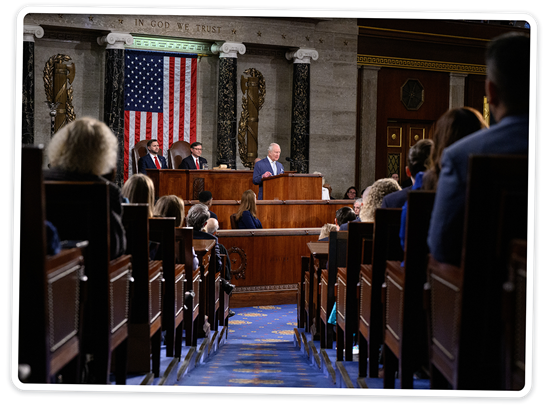
King Charles’ Address to a Joint Session of Congress. On Tuesday, His Majesty King Charles III of the United Kingdom of Great Britain and Northern Ireland addressed a joint session of Congress, marking only the second time a British monarch has addressed the body. (Queen Elizabeth II delivered the first during her visit in 1991.) Delivered in the year of the 250th anniversary of the Declaration of Independence, King Charles’ address was remarkable, celebrating the enduring bond and shared history between the United States and the United Kingdom. I was glad to be in the chamber to hear King Charles highlight the historic and deep alliance between our two nations, highlighting the origins of our founding documents in the Magna Carta (noting it has been cited in U.S. Supreme Court cases since 1789) and the foundational principle that executive power is subject to checks and balances. He also focused on historic partnerships and present challenges, including renewed commitment to the North Atlantic Treaty Organization (NATO), continued support for Ukraine as it continues to defend itself from Russia’s unprovoked war of aggression, and preservation of our environment. (If you look closely in the photo below, you can see the back of my head in the audience, on the left, one seat down from the top.) You can watch the full speech here.
|
Hegseth Oversight Hearings. Also on the Hill this week, Defense Secretary Hegseth appeared before both the House and Senate Armed Services Committees for the first time since the start of the Iran war, which officially hit its 60-day mark on Friday. While the scheduled testimony was the Department of Defense’s (DOD) unprecedented Fiscal Year 2027 budget request of $1.5 trillion, Democratic lawmakers asked important questions on behalf of the American people regarding the Trump administration’s handling of the war in Iran— from the rising costs and economic impact of the war to the administration’s strategic plans. Rather than provide any substantive answers to Congress, Hegseth dodged and deflected—even going as far as to claim that Democrats are the biggest adversaries that he is facing. In this country, people and their representatives discuss, debate, and deliberate. It is at the very heart of our system of government. That Secretary Hegseth thinks patriotic Americans voicing their views are the biggest problem he has shows his utter lack of understanding of the geopolitical and security risks we face, and a lack of faith in the Constitution and the people of the United States that make him unfit for the office he holds. |
While no week in Washington is without its chaos, this week was more chaotic than most, with House Republicans struggling each time the House gathered for a vote. That meant a lot of uncertainty, late-night debate, and very long votes. In the end, a few important things got done – but this is no way to do them.
Perhaps most important to know is that on Thursday, after months of House Democrats urging Speaker Johnson to bring a bipartisan, unanimous Senate plan to fund TSA, the Coast Guard and other agencies in the Department of Homeland Security to the House Floor for a vote, the House finally passed a bill to fund the Department of Homeland Security through September of this year (the end of the fiscal year), after a record 75-day shutdown. (Technically, this was the Senate Amendment to H.R. 7147, Furthering Additional Continuing Appropriations Act, 2026.) The bill does not contain funding for enforcement actions by ICE and CBP, which collectively received an unprecedented $170 billion for immigration and border enforcement in the “One Big Beautiful Bill Act” that Congressional Republicans passed last year and President Trump signed into law. This bill provides hard-working federal employees—including those with the Transportation Security Administration (TSA), Federal Emergency Management Agency (FEMA), and U.S. Coast Guard—much-needed financial stability. While there is still work to do to curb this administration’s abuses, I am glad House Republicans finally joined us in funding the agencies that Americans depend on while withholding additional funding from ICE and CBP. Now, Congressional Republicans must work to address Americans’ legitimate concerns and negotiate on critical reforms to the Trump administration's lawlessness in its immigration and border enforcement practices.
Speaker Johnson and House Republicans struggled to pass the resolution necessary to start the work of this week. There was a lot of drama. In the end, the House considered a Senate-passed budget resolution (S.Con.Res.33), the first step needed to utilize the special budget reconciliation process that makes legislation easier to pass in the Senate. (You may recall President Trump and Congressional Republicans’ used this process last year for the One Big Beautiful Bill Act, which enacted devastating cuts to programs that children, seniors, and hard-working Americans rely on and massive increases in deficit spending and the national debt.) Passing this resolution sets up the process for a second reconciliation bill, which the Trump administration has indicated it would use to provide up to $140 billion to the U.S. Immigration and Customs Enforcement (ICE) and Border Patrol—in addition to the $170 billion in the One Big Beautiful Bill Act. This influx of funding for ICE and Border Patrol is several times greater than their annual budgets. This budget reconciliation does nothing to address rising costs for Americans. I voted against the resolution, which passed the House by a vote of 215-211-1.
On Wednesday, the House considered the Foreign Intelligence Accountability Act (S. 1318) to extend Section 702 of the Foreign Intelligence Surveillance Act, or FISA. You may recall that the House attempted to consider this legislation two weeks ago, but after Speaker Johnson and House Republicans attempted to introduce an amended version of their bill at midnight, with votes expected between 2:00 and 3:00am, the bill failed and the House agreed by unanimous consent a short-term extension of FISA for two weeks to prevent it from lapsing while allowing for further negotiations, expiring this Thursday night. The version of the bill the House considered on Wednesday would reauthorize Section 702 of FISA for three years without meaningful reforms. Members of both parties raised concerns with potential privacy and due process concerns with the program. But rather than engaging with Democrats on this issue, Republicans chose to deliberate amongst themselves and move forward with a reauthorization of the program. I voted against the bill, which passed the House 235-191. The Senate rejected the House bill because it contained an unrelated digital currency ban. With Section 702 FISA set to expire, the Senate passed a separate temporary 45-day extension of FISA Section 702 (S. 4465) to prevent it from lapsing while allowing for further negotiations and sent it back to the House. Although I have serious concerns about this administration’s use (and potential misuse of FISA), I voted in favor of the 45-day extension to allow House Democratic leaders to negotiate a reauthorization that addresses them, and the short-term extension passed the House by a vote of 261-111.
On Thursday morning, the House considered the Farm, Food, and National Security Act of 2026 (H.R. 7567), or “the Farm Bill.” Congress last voted to reauthorize a Farm Bill in 2018 and has since passed continual short-term extensions following the Farm Bill’s expiration in 2023. This Farm Bill was an opportunity to address the $187 billion cut to the Supplemental Nutrition Assistance Program (SNAP) enacted in last year’s One Big Beautiful Bill Act (H.R.1)—the largest cut to the food assistance program in history. (These changes deprived more than 3 million Americans of SNAP—including 323,676 people in Texas.) Tens of millions of Americans rely on SNAP to put food on the table for their families and children. Texas ranks second in the country for the highest number of SNAP recipients and 39 percent of Houston and Harris County households do not have a secure, reliable source of food. This number is far greater than the national average of 14 percent. SNAP contributes $10.73 billion in economic growth to Texas, makes up 12 percent of all grocery sales, and supports more than 94,000 Texas jobs. Yet instead of reversing these cuts, the bill fails to address the food assistance crisis and contains several harmful provisions. In short, the bill does little to address the rising costs that American families and American farmers are facing. And while I believe that we do need a new Farm Bill that addresses critical needs for Texas farmers and ranchers, I believe that the Senate will negotiate a better bill and rejecting this inferior bill is important in making that happen. For these reasons, I voted against the bill, which passed the House by a vote of 224-200 and now heads to the Senate for consideration and amendment.
As a reminder, you can always find a list of all of the votes I have taken for the district on my website. |
This week, I joined my colleagues in cosponsoring several bills on issues important to our community, including: - the Cosmetic Supply Chain Transparency Act, H.R.4434, to amend title VI of the Federal Food, Drug, and Cosmetic Act to ensure the supply chain transparency needed for companies to make safe cosmetics;
- the Cosmetic Hazardous Ingredient Right to Know Act, H.R. 4435, to amend the Federal Food, Drug, and Cosmetic Act to increase transparency with respect to cosmetic ingredients;
- the Cosmetic Safety Protections for Communities of Color and Salon Workers, H.R. 4436, to amend the Public Health Service Act with respect to cosmetic safety, with an emphasis on communities of color and professional salon workers; and
- the No Rewards for January 6 Rioters Act, H.R. 7711, to prohibit the use of Federal funds to compensate individuals who were prosecuted for their involvement in the attack on the United States Capitol on January 6, 2021.
In addition to these bills, I joined my colleagues in sending a letter to President Trump expressing concern about the President’s recent remarks about opening up the U.S. market to Chinese automakers and urging any and all decisive action necessary to prevent such an entry into the U.S. market. |
On Tuesday, the Energy & Commerce Committee's Environment Subcommittee held a hearing on the Environmental Protection Agency’s (EPA) fiscal year 2027 budget with EPA Administrator Lee Zeldin. I’m not a member of this subcommittee, but I asked to participate in this hearing because EPA’s work is important to people across Houston and because EPA has been planning to reduce its presence in Houston for years. In 2019, EPA began a process to relocate the EPA Region 6 lab from Houston to a facility in Ada, Oklahoma (Notably, the EPA Administrator at the time, Scott Pruitt, was from Oklahoma). At the behest of many in our community, I have fought to keep EPA’s Region 6 lab in Houston to ensure that we have access to the rapid air and water quality monitoring that is vitally important to the Gulf Coast during hurricane season and that we need more often than we would like. Over the years, I questioned both the first Trump administration and the Biden administration about this relocation, and I am glad to report that the move has been delayed (for now) to 2027. During EPA’s budget hearing on Tuesday, I again outlined my concerns to EPA Administrator, Lee Zeldin. He agreed to work with me to ensure that a Region 6 lab presence remains in Houston. You can watch my full remarks below.
|
On Wednesday the Energy & Commerce Committee's Energy Subcommittee held a legislative hearing to review bills aimed to help prepare the electrical grid for increased demand for electricity from AI. Many of these bills make incremental improvements to current policy, but they fail to address some of the larger issues we face. I focused my questions on the unintended consequences of one of these bills, which could hurt states’ ability to strengthen their electrical grids to withstand hurricanes and extreme weather. You can watch my full remarks below.
|
Also on Wednesday, the Energy & Commerce Committee’s Subcommittee on Health held a hearing on legislation focused on food safety. Many of these bills include important policy changes to create a healthier food system. I used my time to highlight that the Trump administration has cut staff relating to these programs and to advocate for a separate hearing on the safety of personal care items and cosmetics. It’s important to talk about what we put in our bodies and what we put on our bodies. You can watch my full remarks below.
|
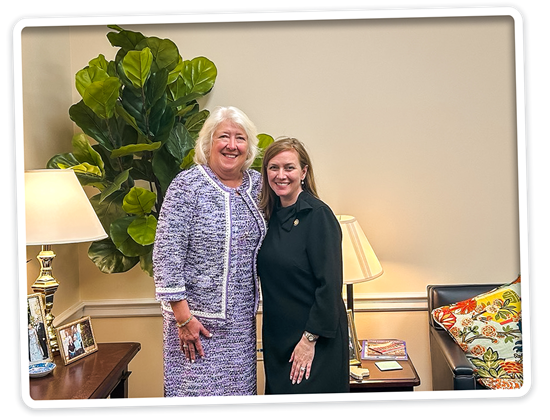
With so many hearings and such a crazy schedule, I didn’t get to participate in as many meetings as usual, but I was glad to see several Houstonians who were in town for different kinds of visits, including King Charles’ address. |
Last Saturday, I was delighted to welcome the top 10 finalists in the annual Congressional Art Competition and their families and friends to our office for a reception and celebration of their talent and work. I am grateful for our judges from the University of Houston, Houston City College, and the Houston Islamic Arts Society for selecting our finalists. Selina Yuan, a student at Saint Thomas' Episcopal School, was this year’s first-place winner, and her painting "Dedication" will soon be hung in the U.S. Capitol. And I am so glad that, once again, our other finalists will let me display their work in our district office for the next year. |
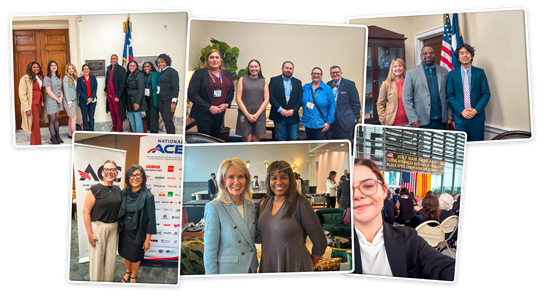
In Washington, Team TX-07 held nearly three dozen meetings with constituents and groups advocating on their behalf, including the American College of Emergency Physicians, Human Rights Campaign Houston, and Friends of the Children, pictured below. Back home in the district, our team was out and about across the district, helping constituents and attending community events, including the Greater Houston Women's Chamber of Commerce Elected Officials Reception, the National ACE Houston Roundtable at PortHouston, and an event recognizing the anniversary of the Fall of Saigon and its impact on Houston’s Vietnamese community. |
Save the date for two in-district events in May! On May 12, TX-07 Constituent Advocates will be at the Chinese Community Center to meet with residents and help answer questions about matters before federal agencies. Stop by anytime between 10 a.m. and 12 p.m.!
|
On May 30, we are hosting another passport fair for (1) first-time passport or passport card applicants and (2) renewal and replacement passports or passport cards at Burnett Bayland. Representatives from the Houston Passport Agency will be present to answer questions and accept applications. Please RSVP here or by clicking the image below.
|
The House will not be in session next week, but our team will be working all across the district. I am looking forward to being at home in Houston with them, and to sharing a report on our activities with you. As always, I am proud to represent you and I am here to help you. Please call my office at (713) 353-8680 or (202) 225-2571 or email here at any time to ask for assistance or share your thoughts. I look forward to hearing from you. Best wishes, |
|