Dear Neighbor,
The House and Senate were back in session this week, and I was in Washington all week. Here’s my report on this week in Congress. |
There was a lot going on in Washington this week, as the House and Senate returned. Here are notes on just a few of the things people were focused on this week:
Arrival of New World Screwworm. As you have likely heard, on Wednesday we learned that a case of New World screwworm was found in Texas. What is New World screwworm? It’s a flesh-eating parasite that we previously eradicated from the United States in the 1960s, under the leadership of Texans. This resurgence spells big trouble for Texas and our $15 billion cattle industry, where an outbreak of screwworm could devastate livestock producers and drive up the already-high cost of beef, costing Texas $1.8 billion alone. Texas cattle ranchers and USDA experts have been warning us about screwworm, and it could not have arrived at a worse time: when beef prices have never been higher and the U.S. cattle herd has reached a 75-year low. A major screwworm outbreak compounded with high input costs, disastrous trade policies, weather extremes, soaring fuel and fertilizer costs, and market volatility is a huge challenge for Texas and the United States.
Even before we learned the screwworm was here, I offered an amendment to the Fiscal Year 2027 Agriculture government funding bill we were set for vote on this week to allocate $10 million to the Animal and plant Health Inspection Service (APHIS) at USDA to directly address the threat of the New World screwworm. Republicans on the Rules Committee rejected my amendment, however, and did not include it in the bill. You can watch my remarks on the House floor during debate below. |
For those who prefer to read, here are my remarks as delivered:
“I rise in opposition to this bill and to object to the House Republicans on the Rules Committee's failure to include the amendment that I offered to increase and decrease funding for the Animal and Plant Health Inspection Service (APHIS) by $10 million to focus on the threat of New World screwworm. And yesterday, we learned that the New World screwworm has been found in Texas. This is something that Texans have been worrying about and have been warning Washington about for nearly two years.
This flesh-eating parasite, previously eradicated from the United States, poses a huge threat to our cattle. And Texas is home to the largest cattle population in the country. More than 12 million cattle and nearly $15 billion cattle industry. We have not seen a screwworm outbreak since the 1970s, and it cost the United States hundreds of millions of dollars and took years to eradicate and contain. An outbreak today will be devastating to U.S. livestock producers and drive up already high costs for beef at the grocery stores that all Americans will see.
For decades, our country has remained relatively pest free thanks to the hard work of the USDA's Animal and Plant Health Inspection Service, which is tasked with eradicating and keeping dangers like screwworm at bay. Last March, though, the Trump administration fired more than 15,000 USDA employees, including more than 1,300 staff at the Animal and Plant Health Inspection Services, leaving our farmers and ranchers vulnerable. And, the DOGE team, in their infinite wisdom, eliminated a program to contain the screw worm in Central America. This is what happens when you do not listen to the experts and the people who know what they're doing.
Congressman Vicente Gonzalez, who represents South Texas, has warned people in Washington that USDA experts have told him we need to be producing 700 million sterile flies [per month]. But the administration hasn't listened. The threat of New World screwworm is just one consequence of the Trump administration's reckless campaign to eliminate funding for government programs and research initiatives that our country invests in and that Americans rely on. And importantly, this Congress's utter failure to do anything about it and failure to stop it.
Rebuilding our federal government's capacity to respond swiftly during crises takes time. And as Texas farmers and ranchers can tell you, we're witnessing a crisis unfold before our eyes right now. For these reasons, and the many others my colleagues have identified, I will be voting against this bill, and I urge my colleagues to do the same.”
I am sorry to say that the federal government is not as prepared to handle it as it should be. As I mentioned in my remarks, just last March, the Trump administration forced out more than 15,000 USDA employees, including more than 1,300 staff at the Animal Plant Health Inspection Services—the agency responsible for containing and eradicating agricultural threats like screwworm. The DOGE effort also eliminated more than 5,300 grants and programs within USAID and other agencies, including those to reduce the spread of infectious parasites and contagious disease, including screwworm, bird flu, and swine flu. President Trump has strained our relationships with Mexico, Panama, and Central American countries, hampering coordinated response efforts against screwworm at a time when we need to be working with our allies.
This is what happens when we do not listen to the people with experience and expertise—ranchers and scientists—who have been sounding the alarm on this New World screwworm for years. I am committed to doing all I can to get the resources we need and the government functioning as it should to invest in the things that help keep us safe and secure here at home in all kinds of ways. There is a reason we pool our resources and invest in programs together.
Attack on Federal Grants. Last Friday, President Trump’s Office of Management and Budget (OMB), released a proposed rule titled “Regulation for Federal Financial Assistance” to revise requirements for federal grants and other forms of federal financial assistance. The proposal specifically targets diversity, equity, and inclusion (DEI) programs, along with “gender ideology,” and broadly expands the Trump administration’s tools for terminating and suspending funding for projects it opposes on ideological grounds. If finalized, OMB’s proposed rule provides a tool for targeted attacks on research and research institutions that don’t align with the Trump administration’s priorities. Hospitals, colleges, universities, academic medical centers, and other research-intensive recipients–many of which are located in Houston–are likely to be impacted by the proposed rule. Members of the public can comment on this proposed rule before July 13, 2026.
Appointment of Director of National Intelligence. This week, President Trump announced that he intended to appoint Bill Pulte, who is currently serving as the Director of the Federal Housing Finance Agency, to serve as the Acting Interim Director of National Intelligence (DNI). This proposed appointment raised serious concerns on both sides of the aisle. The DNI is a critically important role, overseeing the entire United States Intelligence Community (IC), including the Central Intelligence Agency (CIA) and National Security Agency (NSA). Pulte has no known experience in national security, who is, and may not even have the proper security clearances to serve in that role. It is also concerning that Pulte has also used his current role to recommend the Department of Justice investigate President Trump’s adversaries over unproven allegations of mortgage fraud. People on both sides of the Capitol, and on both sides of the aisle, expressed concerns with the President’s choice to promote an unqualified loyalist with a history of using his role to go after critics of the President to oversee the country’s spy agencies. As a result of this announcement, reauthorization of a key provision of the Foreign Intelligence Surveillance Act (FISA) Section 702, which expires next week, looks iffy.
And there was so much more going on. The Senate debated and ultimately passed a bill to fund ICE and Customs and Border Protection (CBP) outside of the congressional appropriations process, and there was a lot of talk about amendments to stop the President’s nearly $2 billion slush fund. In the end, however, Senate Republicans provided about $70 billion in funds through the remainder of President Trump's time in the White House. All Senate Democrats and one Republican, Sen. Lisa Murkowski of Alaska, voted against it. We anticipate voting on it in the House next week. |
This week, led by House Democrats, the House took meaningful steps to rein in the lawless actions of the Trump administration by forcing the House to take up legislation on issues important to the American people.
The House returned on Tuesday, but delayed votes until Wednesday. And on Wednesday, the House passed a resolution to direct President Trump to terminate the use of the United States Armed Forces from hostilities against Iran unless Congress explicitly makes a declaration of war or authorizes use of military force against Iran (H.Con.Res 86). As I have said here before, the United States Constitution states clearly that Congress has the sole authority and solemn responsibility to declare war. It is a foundational principle of American democracy, designed to ensure that the American people have a say in decisions of war and peace through their elected representatives. Since February, the President has refused to seek authorization from the American people for this war, has failed to come to Congress to make the case, and has failed to provide evidence of an imminent threat to the United States to justify this action. This week’s vote is about whether the President of the United States must follow the Constitution. After four attempts—all of which I have voted for—the House finally affirmed that principle this week, passing the resolution 215-208. This is a monumental step in reining in President Trump’s war of choice against Iran. The resolution now heads to the Senate for consideration.
The House also considered the Ukraine Support Act (H.R. 2913), another Democratic-led bill, which we forced to the House floor for a vote through a discharge petition (H.Res. 518). Ranking Member of the House Committee on Foreign Affairs Gregory Meeks (NY-5) introduced the bill to authorize security assistance and economic investments for Ukraine and to impose new financial sanctions and export restrictions on Russia until it ends its war against Ukraine. For years, the Ukrainian people have demonstrated remarkable courage and perseverance in their fight for democracy and the preservation of their sovereignty. I joined all House Democrats and 18 Republicans in voting for the Ukraine Support Act, which passed the House 226-195. It is critical that we hold Russia accountable through tougher sanctions and lay the groundwork for Ukraine's reconstruction, and the Senate should take up this legislation without delay.
The House also considered a war powers resolution to direct President Trump to remove United States Armed Forces from Lebanon (H.Con.Res.84). There are no U.S. servicemembers directly involved in any active combat operations in Lebanon, however, which complicates the use of the War Powers Act. There is a longstanding, limited U.S. military footprint in Lebanon strategically focused on supporting the Lebanese Armed Forces in their efforts to combat Hezbollah’s influence in Lebanon. The potential unintended consequences of this war powers resolution risk strengthening Hezbollah at a critical moment and could undermine ceasefire negotiations and our national security. For these reasons, I voted against this resolution, which failed by a vote of 92-324.
Speaker Johnson brought the following other legislation to the floor this week:
On Wednesday, the House considered the Stop Child Care Scams Act of 2026 (H.R. 7726) which, if enacted, would impose new restrictions and requirements on the Child Care and Development Block Grant (CCDBG) program. Despite the stated purpose, there is no evidence of widespread fraud in the CCDBG program and this bill implements new requirements without providing any additional funding or resources to handle the stricter requirements, even as the Office of Child Care has lost half its oversight staff in the past year. The requirements would, at least, double the amount of administrative paperwork required, forcing states to spend more money on administrative costs and less on families and children. For these reasons, I voted against this bill, but it passed 217-207.
On Thursday, the House considered the Agriculture, Rural Development, Food and Drug Administration, and Related Agency Appropriations Act for Fiscal Year 2027 (H.R. 8646), a government funding bill intended to deliver support for farmers and ranchers, strengthen food and drug safety, and fund important research and innovation—all achievable goals that this Republican bill fell short on. Instead, this partisan bill, cuts overall funding by $1.1 billion compared to last year’s annual funding bill, underfunding vital programs for farmers and ranchers, increasing costs, and threatening food access for hard-working Americans at a time when families and farmers are struggling with inflated prices. This bill also cuts staffing and $19 million in funding for the Farm Service Agency, responsible for helping farmers with federal assistance programs. Unfortunately, this bill also fails to reverse or even acknowledge the damage this administration and this Congress have done to the Supplemental Nutrition Assistance Program (SNAP), instead cutting SNAP and Women, Infants, and Children (WIC) funding by $200 million and making it more difficult for families to access health food options, including fruit and vegetables. And, as I discussed above, this bill does not sufficiently assist Texas cattle ranchers in preparing for the threat of New World screwworm or take any meaningful steps to reverse the more than 15,000 USDA staff reductions or restore the 5,300 cut grants and program and USAID and global agencies—including those responsible for containing and eradicating the spread of screwworm and other agricultural threats. For these reasons, I voted against the bill, which passed the House by 213-210.
On Thursday morning, I spoke on the House floor in opposition to advancing the agriculture government funding bill and about my amendment to call attention to the threat of New World screwworm, which Republicans on the House Rules Committee opted not to consider. You can watch the whole speech above, or also linked here.
The House also considered several bills under suspension of the rules, all of which passed, including the American Battlefield Protection Program Amendments Act of 2026 (H.R. 7618) to extend National Park Service grant programs that preserve U.S. battlefields.
As a reminder, you can always find a list of all of the votes I have taken for the district on my website. |
In my last email, I announced the No Presidential Self-Serving Lawsuits Act, H.R. 8968, to bar any president from initiating civil lawsuits against the U.S. government while in office and to prohibit use of the Treasury’s Judgment Fund to settle civil claims arising out of such a case. Last week, a federal judge blocked the establishment of the fund for two weeks, placing a hold on the creation of the fund. There were lots of discussions about how to prevent this abusive fund all over the Capitol this week, and I will continue to work with my colleagues to do all we can to put an end to this abuse and corruption and ensure that it cannot happen now or in the future.
This week I also co-sponsored several other bills this week of importance to our community, including: - the Bivens Act of 2025, H.R. 6091, to provide a civil remedy for an individual whose rights have been violated by a person acting under Federal authority;
- the Arlington National Cemetery Viewshed Protection Act, H.R. 9047, to restrict the establishment of a triumphal arches within certain areas of the District of Columbia and the capital region;
- the No Funds for Iran War Act, H.R. 8707, to prohibit the use of funds to use military force in Iran;
- the Fairness for Victims of SNAP Skimming Act of 2025, H.R. 3117, to amend the Consolidated Appropriations Act, 2023, to expand the replacement of stolen Electronic Benefits Transfer (EBT) benefits under the Supplemental Nutrition Assistance Program (SNAP); and
- a resolution expressing support for the designation of the month of May 2026 as Progressive Supranuclear Palsy and Corticobasal Degeneration Awareness Month, H.Res. 1318.
In addition, I joined my colleagues in sending several letters to the Trump administration recently, including: - a letter to Secretary of Homeland Security Markwayne Mullin and U.S. Citizenship and Immigration Services (USCIS) Director Joseph Edlow demanding answers regarding the rapidly growing backlog of applications pending before USCIS and the administrative limbo that millions of individuals are experiencing as a result of USCIS’ failure to conduct its core function;
- a letter to Secretary of Health and Human Services (HHS) Robert F. Kennedy Jr. expressing concern regarding the Office of Refugee Resettlement’s (ORR) failure to reimburse legal service providers for unaccompanied immigrant children; and
- a letter to Treasury Secretary Scott Bessent, U.S. Trade Representative Jamieson Greer, Small Business Administrator (SBA) Administrator Kelly Loeffler, and CBP Commissioner Rodney Scott urging federal agencies to share their plans to support small businesses in accessing the IEEPA tariff refunds they are legally entitled, calling for an automatic refund process for small businesses impacted by these tariffs, and requesting consideration of direct relief to American consumers who paid the majority of tariff-induced costs.
I also joined my colleagues in filing two amicus briefs in federal courts. The first in the U.S. Court of Appeals for the District of Columbia Circuit in the case of Trump v. District of Columbia, supporting of the District of Columbia's challenge to the President's unlawful deployment of National Guard troops to police Washington, D.C. over the objection of local elected leaders. And the second, also in U.S. Court of Appeals for the District of Columbia Circuit, in National Trust for Historic Preservation v. National Park Service, supporting the National Trust for Historic Preservation’s challenge President Trump’s demolition of the East Wong of The White House without congressional authorization or appropriation. As we argued in the brief, because the White House is federal property, Congress is responsible for determining whether (and, if so, how) its various parts should be demolished or reconstructed. Congress passed the initial legislation to build the White House and, since then, has repeatedly passed legislation to provide for its expansion, maintenance, and renovation as needed. |
On Thursday, I joined a small group of my Energy & Commerce Committee colleagues for a meeting at the Department of Health and Human Services (HHS) with Director of the National Institutes of Health Director and Acting Director, Centers for Disease Control and Prevention Dr. Jay Bhattacharya to discuss the administration’s response to the Ebola and Hantavirus outbreaks. We also discussed HHS’ preparation for the World Cup. With Houston hosting the World Cup starting next week, it is important to ensure that Houston and host cities across the country are prepared—and that the United States continues its leadership role in the world in protecting public health. Recent decisions and efforts from the Trump administration—from dismantling USAID to withdrawing from the World Health Organization—have a huge impact on public health at home and around the world. While the meeting was useful, but we have much work to protect public health, health research and scientific research generally in the United States. |
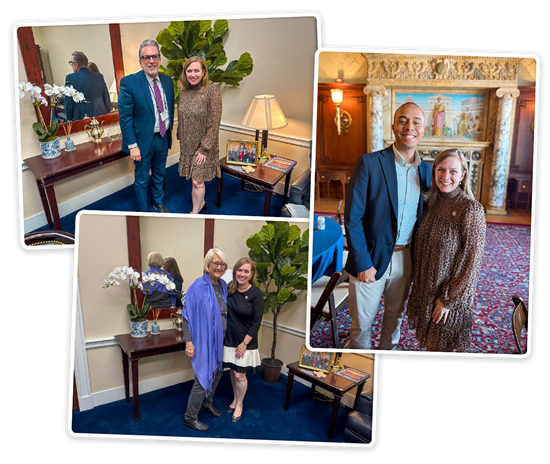
It’s always, always good to see Houstonians on the Hill, and this week I got to welcome some very special ones. Glad to sit down and talk about work to assist families and communities across Houston and more! And I was so thrilled to welcome back to D.C. our new District Director, Bricen, at the Library of Congress during this week’s District Directors Conference. Many of you already know Bricen, who joined our team in 2020 and has worked in our offices in both Washington and Houston over the last seven years, most recently as outreach director in Houston. |
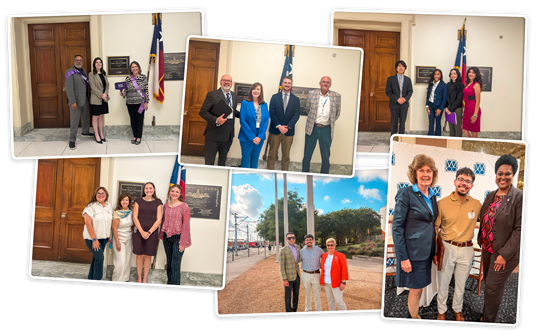
In Washington, Team TX-07 held more than a two dozen meetings with constituents and groups advocating on their behalf, including the Alzheimer’s Association, Concord Action, Students Engaged in Advancing Texas, and the Texas Council on Family Violence and Texas Association Against Sexual Assault, pictured below. Back home in the district, our team was out and about across the district, helping constituents and attending community events, including the LGBTQ+ Chamber of Commerce Pride Flag Raising Ceremony and the Greater Houston Women's Chamber of Commerce's Fort Bend Chapter Luncheon with Mayor Carol McCutcheon and Mayor Pro Tem Martha Castex-Tatum, pictured below. |
June is Pride Month. And I am so proud to represent the diverse and dynamic LGBTQI+ community throughout TX-07, including the historic and vibrant heart of the community in Montrose. I am honored to bring our welcoming, inclusive, and affirming values to Washington, including in my role as a Vice Chair of the Congressional Equality Caucus. I look forward to celebrating with neighbors all month, and fighting for equality for all Americans all year! |
Save the date for our next Constituent Services Pop-Up! On June 11, TX-07 Constituent Advocates will be at the Metropolitan Multi-Service Center to meet with residents and help answer questions about matters before federal agencies. Stop by any time between 10 a.m. and 12 p.m.! |
I was glad to be back home in Houston last week, and to participate in events across the community—including casting my ballot in the runoff elections on election day. From joining Houston City Council and local leaders celebrating Council Member Abbie Kamin’s at beautiful new Ismaili Center in TX-07 to joining the Alpha Kappa Alpha Sorority Inc. for their State of Women in Texas Forum to seeing constituents at our TX07 Passport Fair at Burnett Bayland Community Center, it was a great week of connection and collaboration. |
I also appreciated the opportunity to sit down with Craig Cohen on Houston Matters last Friday to discuss my new bill, the No Presidential Self-Serving Lawsuits Act, H.R. 8968. You can watch the full interview here. TLDR: The American people deserve better, and we all have to participate in our democratic system and demand it. |
Tomorrow, we remember and honor the United States and Allied Forces who fought fascism during World War II, and in particular the courage and commitment of our servicemembers on D-Day. It's especially important to remember now what they were fighting and what they were fighting for. We honor them by fighting for and against those same things now, in all the ways we can. |
The House will be back in session next week, and I will be in Washington next week where House Republicans plan to bring to the floor the Senate’s $70 billion immigration agency funding bill and when Section 702 of the Foreign Intelligence Surveillance Act (FISA) is set to expire next week. We will consider these and other bills, and I will send you a report back next week. As always, I am proud to represent you and I am here to help you. Please call my office at (713) 353-8680 or (202) 225-2571 or email here at any time to ask for assistance or share your thoughts. I look forward to hearing from you. Best wishes, |
|