Dear Neighbor,
This week was the second week in a row that the House Speaker sent the House home with little progress. Here is my report on another week that was—and wasn’t. |
This was the final week of the term for the Supreme Court of the United States, which issued several major decisions, including:
Affirming birthright citizenship. On Tuesday, in the case of Trump v. Barbara, the Supreme Court affirmed that the Fourteenth Amendment to the Constitution, ratified in 1868, establishes that all people born in the United States and subject to its jurisdiction are U.S. citizens. The President cannot simply amend the United States Constitution by executive order. If you are born in the United States of America, you are an American. With this decision, the Supreme Court rejected the President’s attempt to rewrite our Constitution with the stroke of his pen.
Granting more power to the President over independent agencies. On Monday, the Supreme Court ruled on two cases involving the President’s power to fire members of independent agencies. In the case of Trump v. Slaughter, the Court struck down a federal law barring the President from firing Federal Trade Commission (FTC) Commissioner Rebecca Slaughter, overruling its 91-year-old decision in Humphrey’s Executor v. United States and expanding the President’s power. In Trump v. Cook, however, the Court refused to let the President fire Federal Reserve Governor Lisa Cook, ruling that the Constitution protects the Fed’s removal restrictions even as it strips away similar protections for the FTC. Congress has created many independent agencies to oversee important decisions impacting the safety and prosperity of Americans, including the Consumer Product Safety Commission, the Federal Energy Regulatory Commission, the Equal Employment Opportunity Commission, and many others. Congress made these agencies independent on purpose: to insulate their important work from politics to a greater degree than other cabinet agencies. The Supreme Court's rulings in these two cases appear to grant the President the ability to intervene in other independent agencies, making their members subject to removal by the President without cause. The potential for any President to replace commissioners from independent agencies with ideological allies and bring politics into their work is deeply problematic and will be an important issue for Congress to address.
Also announced this week, the contents of President Trump’s Financial Disclosure. The U.S. Office of Government Ethics released President Trump’s 2025 financial disclosure forms, as the law requires. You may have seen it in the news. The short version is that President Trump made at least $2.2 billion during the first year of his second term, compared to $622 million in 2024, before he returned to the presidency. That’s about a $1.5 billion increase in earnings during his year in office. The 927-page document shows that $1.4 billion of that amount President Trump earned in crypto. Celebration Coins, an entity presumed to manage the $Trump meme coin despite having no digital footprint, accounted for $635 million of that total. The disclosure also revealed more than $78 million in legal settlements that companies paid President Trump after he sued them following his return to office ($16 million from ABC, $16 million from CBS, $24.5 million from Meta, and $22 million from YouTube). You can read much more detail in the stories covering this disclosure. And you should. This is not normal. |
This weekend, the United States will celebrate the 250th anniversary of the signing of the Declaration of Independence and the founding of our country. Our founders pledged their lives, their fortunes, and their sacred honor to establish a new form of government--one that would inspire others and change the course of human history.
As Americans, we have much to celebrate. And while much work remains to make ours a more perfect union, this month and in the months that follow I will celebrate and share the milestones that remind us of the promise and the power of American democracy, and the progress we have made when we work together to secure liberty and justice for all, beginning with the courage and vision articulated 250 years ago Saturday in the Declaration of Independence. |
I’ll share these here and on my social media accounts. (If you don’t already subscribe or follow me on social media, I hope you will sign up now.) |
There were not a lot of votes this week. Why? Because, for the second week in a row, a small group of House Republicans brought House business to a halt. Here is what happened:
The House returned on Monday, planning to debate and vote on the National Defense Authorization Act for Fiscal Year 2027 (H.R. 8800), which authorizes defense spending for the year, and the National Security, Department of State, and Related Programs Appropriations Act, 2027 (H.R. 8595), which funds foreign assistance, as well as the disingenuously named Removing Barriers to Work for Disabled Americans Act (H.R. 8884) and a resolution commemorating the one-year anniversary of the enactment of the One Big Beautiful Bill Act (H.Res. 1383).
But, once again, a group of House Republicans voted against proceeding with debate on these bills on Tuesday. Why did they do this again? Because they want Congress to pass the SAVE America Act (H.R. 7296), a bill that the House has already passed once, and that the Senate has already said it does not have the votes to pass. (As a reminder, the so-called SAVE America Act that the President and Republicans are claiming protects our elections does the opposite: it undermines them. We all agree that only American citizens are eligible to vote in federal elections, and that only American citizens should vote in those elections. And that is why it is already the law. This bill isn’t directed at noncitizens, it’s directed at voters, adding burdensome requirements for every American seeking to register (or re-register) to vote, including those who have changed their addresses or changed their names. When registering or re-registering to vote, Americans would have to provide documents proving their citizenship, like a passport or birth certificate, and to do so in person, effectively eliminating voter registration methods that more than 90 percent of Americans use to register to vote.)
To put this into context, the vote this week marked the fifth vote of this kind this Congress, the ninth time under Speaker Johnson, and the 12th failed time since Republicans took control of the House in 2023. Before that, this had happened only eight times since 1995 (six failed under Speaker Newt Gingrich and two under Speaker Dennis Hastert).
As a result of all this dysfunction, the Speaker adjourned the House on Tuesday evening and sent everyone home early for the week. I was not going to vote for these bills, anyway, but this is not how things should work.
The House did take a few votes this week, starting on Monday when it passed the Kids Internet and Digital Safety (KIDS) Act (H.R. 7757), a package of several bills to protect kids online that the Energy & Commerce Committee negotiated after years of work. Congress has not passed new, comprehensive legislation to protect children online for nearly 30 years, since the enactment of the Children’s Online Privacy Protection Act (COPPA) in 1998. The bill passed by a vote of 267 to 117.
The KIDS Act is a meaningful step toward protecting children and teens online by regulating how internet platforms, social media companies, and video games treat minors. It includes a ban on targeted advertising to children, limits how much personal data companies can collect from kids, creates the first-ever federal registry of data brokers (closing a loophole that allowed companies to buy and sell kids’ information secretly), requires safety settings by default for children and teens, and adds guardrails on addictive features designed to keep kids on their phones. The bill is not perfect, and colleagues and groups have raised concerns about what is not included. Please know that it is not the end of our work, but it is important to respond to the parents, doctors, teachers, and advocates who have made clear that we must act to reduce the harms that too many kids experience online. This bill strengthens privacy protections for children and teens, gives families more control, and preserves parents’ ability to seek justice in court. It sets a floor on protecting harms, not a ceiling, and makes it possible for states to do more. I will keep working with colleagues and partners in Washington and at home to protect kids and teens online.
On Tuesday, the House considered a war powers resolution to bar U.S. Armed Forces from engaging in hostilities in Lebanon without authorization from Congress (H.Con.Res.108). The Constitution is clear: Congress has the power and the responsibility to declare war. While people in our district and across the country share deep concerns about escalating violence in the region, the United States should not be drawn into another conflict in the Middle East without the authorization of the representatives of the American people. Following President Trump’s reckless and unauthorized war in Iran, this resolution prohibits U.S. forces from engaging in hostilities in Lebanon without authorization from Congress, while preserving the longstanding mission of training and supporting the Lebanese Armed Forces—a partnership that administrations have rightly recognized as essential to Lebanon's stability and to the security of the region. For these reasons, I voted for this resolution, which failed by a vote of 189-235.
The House also considered a resolution dealing with sexual harassment and misconduct in the House, a resolution directing the Committee on Ethics to preserve and publicly release records relating to monetary settlements involving acts of sexual harassment (H.Res.1399). This resolution requires the Committee on Ethics to release the names of the Members of Congress whose sexual misconduct investigation led to a settlement, along with the total amount of the settlement. As a practical matter, the Office of Congressional Workplace Rights (OCWR) is already required to publish an annual report detailing payments made to resolve harassment claims, including member names. So, it is duplicative, but I voted yes on the resolution to affirm the importance of promoting transparency and accountability. The resolution passed unanimously, with one member voting present.
As a reminder, you can always find a list of all of the votes I have taken for the district on my website. |
This week, I joined my colleagues in sending a letter to the Office of Management and Budget (OMB) Director Russ Vought opposing OMB’s proposed changes to the Uniform Guidance that would give political appointees final say over all grant decisions and sideline the longstanding and trusted peer-review process. This proposed rule makes it easier for agencies to cancel grants that are already in progress, weakens the role of expert scientific review in funding decisions, gives the public fewer opportunities to weigh in when agencies set their own grant policies, and limits how much flexibility agencies have to tailor those policies to the communities they serve. The bottom line is that by putting political judgment ahead of scientific expertise, OMB is attempting to steer taxpayer funding only to recipients and projects that align with the values of the current administration. The good news is that this rule is not yet final. Before OMB can put it in place, the agency is required to accept public comments from people across our country. As you will see in the “Events” section below, we hosted a webinar on this rule this week, and you can find out more there about how you can have your say.
I also joined a letter to U.S. Citizenship and Immigration Services (USCIS) Director Joseph Edlow demanding the reversal of the recent USCIS policy memo changing the process for immigrants applying for lawful permanent residence (green cards).
In addition to these letters, I also co-sponsored several bills important to our community, including: - the Dignity and Due Process for Children Act, H.R. 9270, to establish clear, enforceable protections for immigrant children in federal custody, prohibiting ICE from detaining unaccompanied children, banning coerced legal waivers, and barring military resources from child deportations.
- the Protecting America’s Herds Act, H.R. 9377, to establish a grant program for preparing and responding to New World screwworm outbreaks;
- the TWIC Efficiency (TWICE) Act, H.R. 5109, to require the Administrator of the Transportation Security Administration (TSA) of the United States to improve access to the Transportation Worker Identification Credential (TWIC) program by assisting those currently in Federal, State, or local prisons through the TWIC card application process to gain this credential needed for specific transportation sector jobs;
- the Alzheimer's Screening and Prevention Act of 2025, H.R. 6130, to amend title XVIII of the Social Security Act to provide for Medicare coverage of blood-based dementia screening tests;
- the Lone Star Coastal National Recreation Area Act, H.R. 9325, to establish the Lone Star Coastal National Recreation Area to conserve, protect, and promote the economic benefits of the natural, cultural, and recreational resources of the Upper and Middle Texas Gulf Coast as a unit of the National Park System, and
- a resolution celebrating the country’s history of church-state separation and recognizing the 250th anniversary of the founding of the United States.
Finally, I joined my friend and colleague Congressman Jamie Raskin (MD-08) in signing a discharge petition to force a floor vote on legislation to permanently block President Trump’s nearly $1.8 billion slush fund. Nearly a month ago, Acting Attorney General Todd Blanche told Congress the administration was not moving forward with the fund. We have learned, however, that we cannot take this administration at its word. The American people deserve more than assurances—they deserve certainty. It’s time to bring this legislation to the floor for a vote to ban this fund.
In May, I introduced the No Presidential Self-Serving Lawsuits Act, H.R. 8968, to ensure that no president can use the office for personal financial gain. The bill prohibits any sitting president from bringing civil lawsuits against the federal government and bars the use of the Treasury’s Judgment Fund to settle claims a president filed while in office, even after leaving office. This “weaponization fund” is a staggering level of corruption, even for this administration, and I am glad to support efforts to close this loophole and ensure taxpayer dollars cannot be used to finance any president's personal legal agenda. |
As I mentioned above, proposed changes to the federal grant process are of great concern to me and to people across our district. Federal grants fund important work all across our community—from medical research to small business startups to safety initiatives to road improvements. All kinds of programs we rely on are funded through federal government grants awarded to the state, cities, counties, non-profit organizations, and educational institutions.
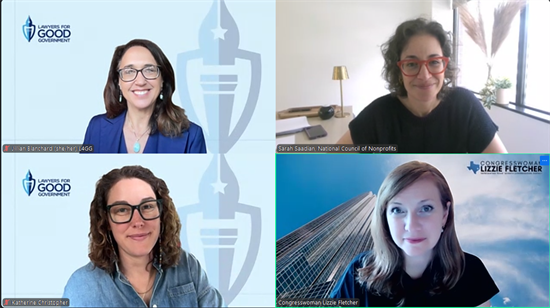
On Wednesday, I hosted a webinar with experts from Lawyers for Good Government and the National Council of Nonprofits to help people in our community learn more about the proposed changes: what OMB is proposing, what it would mean for grant recipients, and how to write a public comment that agencies will read and take into consideration before the changes are finalized. |
The bottom line is that the changes OMB has proposed would give federal agencies more power to cancel grants already in progress, centralize decision-making, and politicize the process. Organizations that our community relies on—including hospitals, universities, nonprofits, and local governments—could see funding for ongoing projects canceled or limited for political reasons with little to no warning or recourse.
I’ve already sent the letter to OMB opposing these changes, as discussed above. You can, too. The period to submit comments is open until July 13, 2026. To learn more, you can watch the webinar recording here. To submit a public comment, click here. |
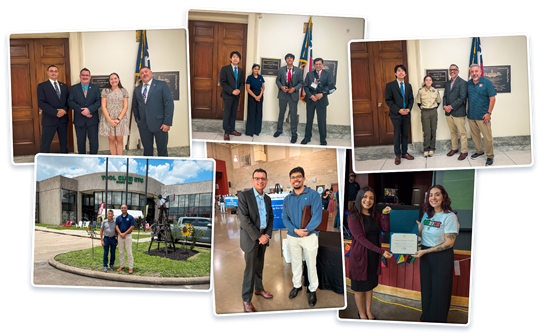
In Washington, Team TX-07 held more than a dozen meetings with constituents and groups advocating on their behalf, including the Coalition of Hindus of North America, the Brotherhood of Locomotive Engineers and Trainmen - International Brotherhood of Teamsters (BLET-IBT), and a TX-07 Scout working to earn her "Citizenship in the Nation" merit badge, pictured below. The team also met with the Association of Minority Health Professions Schools, Trans Unity Coalition, Liquid Energy Pipeline Association, Nuro, and the Edison Electric Institute.
Back home in the district, our team was out and about across the district, helping constituents and attending community events, including attending METRO's Gulfton BRT Community Meeting and BakerRipley's Naturalized Citizens Celebration and visiting the Tool Club on Harwin, pictured below. |
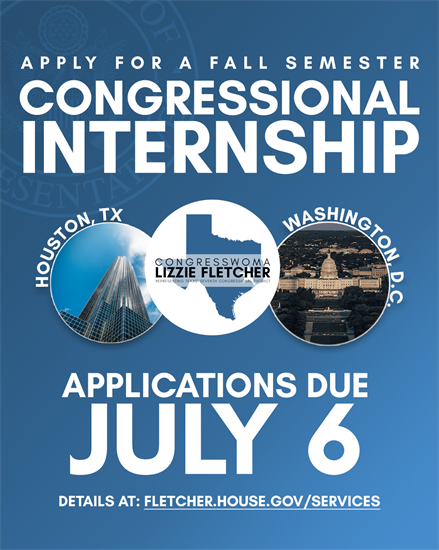
Last call for fall internships! College students interested in interning in my Houston or Washington offices have less than one week left to apply for fall internships. You can find more information about the application process by clicking here or on the graphic below. |
Save the Date! On Saturday, July 18, 2026, our team will host another passport fair for (1) first-time passport or passport card applicants and (2) renewal and replacement passports or passport cards at the City of Bellaire Civic Center. Representatives from the Houston Passport Agency will be present to answer questions and accept applications. Please RSVP here or by clicking the image below. |
This Saturday, as we mark 250 years of independence, we have the opportunity to reflect on what it means to us—freedom, independence, equality, life, liberty, and the pursuit of happiness—on our past and present, and on what we will do to preserve and protect those ideals and secure the blessings of liberty for all Americans for the next 250 years.
As we celebrate this anniversary, I want to hear from you: What does July 4 mean to you? Click here to share your thoughts. |
The House is out of session until July 13. Our offices in Houston and Washington will be closed on Friday, July 3 to observe Independence Day and will reopen on Monday, July 6.
This Independence Day weekend also marks the one-year anniversary of the Hill Country floods that devastated so many families here at home and across the state. My heart is with them this weekend, as we continue to grieve, remember, and celebrate the loved ones lost in this tragedy.
As always, I am proud to represent you and I am here to help you. Please call my office at (713) 353-8680 or (202) 225-2571 or email here at any time to ask for assistance or share your thoughts. I look forward to hearing from you.
Best wishes, |
|