Dear Neighbor,
It was a full week in Houston and in Washington. I’m glad to provide this report on this week’s work in Congress. |
Airport Wait Times. Just like in Houston, people in Washington were talking about the long security screening lines at airports across the country—and what we can do about it. As you no doubt know, the longest lines in the country this week were in Houston. The Transportation Security Administration (TSA) has said it is experiencing its longest wait times in its history. As discussed in more detail below, the TSA employees at airports throughout the country have been working without pay. Understandably, many of them have had to find other work. More than 500 TSA officers have resigned in the last few weeks, and many more are not able to get to work.
Department of Homeland Security Funding. Of course, the funding for the Department of Homeland Security (DHS) is central to the issues at our airports. As I mentioned last week, House and Senate Democrats have repeatedly proposed funding law-abiding agencies under the Department of Homeland Security, including TSA, FEMA, CISA, and the Coast Guard. Early Friday morning, the Senate passed a bipartisan compromise bill to fund most of DHS, except for enforcement actions of U.S Immigration and Customs Enforcement (ICE) and Border Patrol. The House, however, took a different path, as discussed below.
War in Iran. Thirteen American service members have been killed and more than 300 injured in the war with Iran as of today. This week, we learned that the President and the Pentagon are preparing to deploy thousands of U.S. troops to Iran in the coming days. Members of Congress on both sides of the aisle have expressed deep concern that the Pentagon is failing to provide information to Congress, including during a classified Member briefing this week. House Armed Services Committee (HASC) Ranking Member Adam Smith (D-Wash.) led a letter Friday signed by all HASC Democrats and sent to Chairman Mike Rogers (R-Ala.) asking him to convene a public hearing immediately and bring in the Department of Defense to testify on President Trump’s war against Iran. In the letter, Smith and the HASC Democrats wrote, “We remain concerned by the ever-shifting strategic and operational objectives of the conflict and lack of clarity regarding the possible use of U.S. ground forces in the region. This conflict has already resulted in the deaths of 13 U.S. service members and an additional 290 wounded. It has also resulted in the deaths of over a thousand civilians and had sweeping impacts on the domestic and global economy as well as the stability of the Middle East. Additionally, our questions remain unanswered about the costs incurred, including daily operations, lost and damaged equipment, munitions expenditures, and reports that the administration plans to ask Congress for a $200 billion supplemental.” You can read the full letter here.
Incursions at Home. This week, we also learned that, over several days, unauthorized, sophisticated drones entered the airspace above Barksdale Air Force Base in Louisiana, headquarters of the Air Force’s Global Strike Command, forcing a temporary shelter-in-place order. Barksdale Air Force Base is responsible for the nation’s nuclear intercontinental ballistic missiles and strategic bomber forces. Recently, unidentified drones were also spotted over Fort Lesley J. McNair military base in Washington, where State Secretary Marco Rubio and Defense Secretary Pete Hegseth live. On another, but important note, on Friday, we learned that hackers claiming to be working with the Iranian government hacked FBI Director Kash Patel’s personal email account. |
The House convened on Tuesday, and we voted on just one bill under suspension of the rules. Consistent with my messages to you this year, I voted against this bill.
On Wednesday, the House considered the Make the District of Columbia Safe and Beautiful Act of 2026 (H.R. 5103), a bill to create a federal commission to oversee law enforcement and crime prevention efforts and establish a beautification program in Washington, D.C. I voted against this bill, consistent with my prior votes and my view that Congress should not undermine the self-determination of nearly 700,000 residents in Washington, D.C. and impede the D.C. government’s ability to govern through its elected representatives. This bill passed the House 218-206.
This week, the House also considered the Defending American Property Abroad Act of 2026 (H.R. 7084), a bill to allow the President to deny foreign ships entry into U.S. ports if they accessed a port in Western Hemisphere countries where U.S. property has been seized or nationalized. This bill largely relates to a dispute between the Mexican government and a U.S.-based company, but it also grants additional powers to the President that can undermine important trade relationships with allies utilizing broad, sweeping, unchecked powers to continue to manipulate free trade. For these reasons, I voted against this bill, which passed the House 247-164.
On Thursday, the House considered legislation regarding funding for the Department of Homeland Security. First, the House considered a non-binding resolution “expressing the support of the House of Representatives for the Department of Homeland Security” rather than a bill with a realistic path to becoming law to pay the public servants at DHS who are not being paid (H.Res. 1128). Next, the House considered the Pay Our Homeland Defenders Act (H.R. 8029), a bill to provide $64.4 billion to the Department of Homeland Security for Fiscal Year 2026, fully funding all of DHS. This bill is nearly identical to the other two Fiscal Year 2026 DHS appropriations bills that the House passed earlier this year, largely along party lines. Once again, the bill makes no reforms to ICE or CBP and falls short of addressing American’s legitimate concerns about the Trump administration’s lawless actions, including the deaths of American citizens in the streets and abuses in detention. I voted against both, but they passed the House by votes of 218-206 and 225-187, respectively.
Later that evening, President Trump announced that he would sign an Executive Order instructing the DHS secretary to pay TSA agents using funding Congress authorized in the so-called One Big Beautiful Bill Act (OBBBA). There is approximately $7 billion available in a specific account that can be used to pay TSA. On Friday, he signed that order. This is good news for our hard-working TSA agents, and for the traveling public. It also begs the question of why the President did not do this sooner, as he has done with ICE and CBP.
Around 3:00am Friday, the Senate unanimously passed a bipartisan compromise bill to fund most of DHS, except for enforcement of U.S Immigration and Customs Enforcement (ICE) and Border Patrol, which Congress pre-funded last year in the OBBBA with more than $100 billion. (This is essentially the same thing House Democrats have been asking the Speaker to do.) Most people assumed the House would take up the bill on Friday. And the House could have considered the Senate bill and passed it to end the partial government shutdown.
Instead, House Republicans objected to the Senate bill and refused to consider it. They proposed instead passing a 60-day continuing resolution to fund all of DHS, a bill that the Senate said on Friday would be “dead on arrival.” The House stayed in session late into Friday evening and voted on a procedural resolution (H.Res. 1142), the House Amendment to the Senate Amendment to H.R. 7147, that funds all agencies at the Department of Homeland Security (DHS) at current funding levels until May 22, 2026.
In doing so, Speaker Johnson and House Republicans chose to reject the bipartisan Senate compromise and continue the partial government shutdown. They passed the bill last night, and sent it to the Senate. During the vote, House Democrats used a procedural vote to try and bring the Senate bill to the floor for consideration, but we were outvoted. No further action on the continuing resolution is expected in the Senate at this time. The House is now in recess, and members are returning home.
I have heard from so many people at home about concerns about immigration enforcement actions at home and across the country. Democrats in Congress have demanded that the Trump administration follow the Constitution, have proposed a number of common-sense reforms as a part of these funding negotiations, including the proposal the Senate passed to fund other DHS agencies including the Transportation Security Administration (TSA), Federal Emergency Management Agency (FEMA), and the U.S. Coast Guard while negotiations on immigration enforcement activities continue. House Republicans have rejected this approach since January, including the demand that government agents comply with the Constitution.
This year, Americans have witnessed immigration enforcement agents kill American citizens with impunity, have learned of inhumane treatment of immigrants and citizens, and have demanded our country do better. House Republicans have so far refused to do so. Republicans control the House, the Senate, and the White House. To earn my vote, they must present a funding bill that meets the moment, curbs this administration’s abuses, and demonstrates that no agent or agency of the United States government is above the law.
This impasse and the reasons for it are a failure of Congress, and it is a distressing time for the country. I know many people are taking to the streets today to demonstrate their views, at home and beyond. I encourage everyone to do all you can to make your voice heard on these and other issues. I am always glad to hear from you. Democracy is not a spectator sport.
As a reminder, you can always find a list of all of the votes I have taken for the district on my website. |
As I wrote to you last week, most of the legislative work in our office has centered around this year’s appropriations requests, and that work continued this week. This year, I was glad to spearhead several letters to the appropriations subcommittees about funding priorities, including: - a letter with Congresswoman Judy Chu (CA-28) and Congresswoman Sharice Davids (KS-03) urging Congress to increase funding for the Title X Family Planning Program (Title X) to $512 million. This vital program is critical in our community and across the country.
- a letter with Congresswoman Val Hoyle (OR-04) and Congressman Joe Neguse (CO-02) requesting that Congress provide at least $605 million in funding in FY27 for the National Oceanic and Atmospheric Administration (NOAA) Office of Oceanic and Atmospheric Research (OAR), which will allow OAR to continue its critical mission to prepare our communities for natural disasters and to keep the U.S. at the forefront of atmospheric and oceanic research and science.
- a letter requesting $45 million for Texans wrongly denied disaster relief after Hurricane Harvey under a “duplication of benefits” rule. It is important that we right this wrong and work to provide Houstonians the relief that they need.
- a letter requesting that Congress prohibit any federal funds from going toward additional Immigration and Customs Enforcement (ICE) hiring or transfers at this time. As Americans across the country express deep concerns about ICE agents violating our rights, including detaining and killing U.S. citizens, a hiring freeze at the agency is needed until there is accountability, transparency, and procedural reform to ensure the safety of the American people.
- a letter requesting that Congress allocate funding for technologies and research to reduce emissions within the energy sector, specifically in natural gas development and related supply chains.
This week, I joined my colleagues in cosponsoring several bills on issues important to our community, including: - The Homeland Security Continuity and Accountability Act, H.R. 7844, to authorize the use of unspent immigration enforcement funds for ICE and CBP, granted under the One Big Beautiful Bill Act (OBBBA), to reopen essential DHS functions, including TSA, FEMA, and the U.S. Coast Guard;
- the Momnibus Act, H.R. 7973, a package of 14 bills that comprehensively address maternal mortality, morbidity, and disparities nationwide;
- the Direct File Act, H.R. 7806, to reverse the Trump administration’s decision to end the Direct File program, which allowed taxpayers to file their taxes online for free, directly with the Internal Revenue Service and to codify the Direct File program;
- the Guaranteeing and Upholding Americans' Right to Decide Responsible AI Laws and Standards (GUARDRAILS) Act, H.R. 8031, to repeal President Trump’s executive order that would establish a moratorium on state-level artificial intelligence (AI) policies and ensure that states can enact safeguards to protect their citizens;
- the Ensuring Community Access to Pharmacist Services Act, H.R. 3164, to provide Medicare coverage of pharmacist-administered tests for common respiratory illnesses and to allow pharmacists to prescribe treatments for those illnesses; and
- a resolution providing for congressional disapproval of the rule submitted by the Department of Veterans Affairs relating to "Reproductive Health Services,” H.J.Res. 144.
|
On Wednesday, the House Energy & Commerce Committee held a markup on two public safety bills, the Mystic Alerts Act, which I introduced with my colleagues Congressman August Pfluger (TX-11), Congressman Marc Veasey (TX-33), and Congressman Buddy Carter (GA-01) and The First Responder Network Authority Reauthorization Act, which reauthorizes and reforms FirstNet, a critical public safety resource. The Mystic Alerts Act aims to address gaps in public safety communications in response to the devastating floods in the Hill Country last summer. This bipartisan legislation requires the Federal Communications Commission (FCC) to encourage mobile service providers to adopt technology that allows more people to receive life-saving alerts through satellite alerting capabilities (which they can get even if they lack cellular service). This bill is a small but important way to try to help prevent another tragedy. You can watch my statement about the importance of this bill below. |
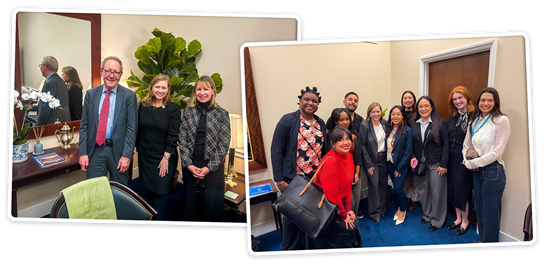
I am always glad to see Houstonians on the Hill. And this week, I was happy to have some time in the office to visit with the Texas Access to Justice Commission and with students from the University of Houston’s School of Social Work to talk about their concerns and legislative priorities. |
Before I returned to Washington on Tuesday, I was glad to be able to participate in CERA Week in Houston. On Monday, I joined my colleague Kathy Castor, our Energy & Commerce Committee Energy Subcommittee Ranking Member, at the GRB for a fireside conversation about energy policy efforts in Congress. We also joined the Sustainable Energy & Environment Coalition Institute (SEEC Institute) and our friends at Rice University for a roundtable discussion at Greentown Labs before we headed back to D.C. Many thanks to Rice and to our TX07 neighbor and Rice Professor Dan Cohan who moderated the discussion. I also joined a bipartisan congressional delegation of members from across the country who came to town to participate in the important conversations about all things energy. |
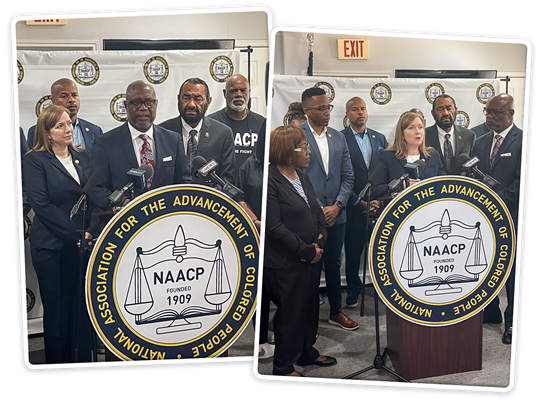
Also while I was home, I was glad to join Bishop James A. Dixon III and members of the NAACP Houston Branch for a press conference to express opposition to the so-called SAVE America Act. As I noted then, the bill that the President and Republicans are claiming protects our elections does the opposite: it undermines them. It is more than a solution in search of a problem – it is a problem. And it’s going to create more problems for millions of Americans.
To the first point, there is no evidence to suggest that noncitizen voting in federal elections is happening in any significant amount; and certainly not one that requires this kind of response. Second, it is already illegal. We all agree that only American citizens are eligible to vote in federal elections, and that only American citizens should vote in those elections. And that is why that is already the law.
This bill isn’t directed at noncitizens. It’s directed at voters. It adds burdensome requirements for every American seeking to register (or re-register) to vote, including those who have changed their addresses or changed their names. When registering or re-registering to vote, Americans would have to provide documents proving their citizenship, like a passport or birth certificate, and to do so in person. That requirement would effectively eliminate voter registration methods that more than 90 percent of Americans use to register to vote, including voter registration drives, mail-in voter registration, and, for some, registering at the DMV. Providing these documents would not be a one-time ordeal, but it would require Americans to show them to an election official every time they update their voter registration information for things like moving.
Under the SAVE Act, Americans would need to bring their passport or birth certificate with them to the polls, every single time they vote—not a photo ID like your driver’s license—your passport or your birth certificate. A lot of people don’t have a copy of their birth certificate. And nearly 70 million women who have taken their husband’s last name do not have a birth certificate matching their legal name. Half of Americans—more than 140 million citizens—do not have a valid passport. It costs $165 to apply for a new passport or $130 to update your passport, which expires every 10 years. This is nothing other than a poll tax, which the Supreme Court has found is unconstitutional.
Congress should be ensuring the ability of Americans to participate in our democracy, not suppressing it. I have voted against this bill and I will continue to do so. |
You can watch the full press conference here. |
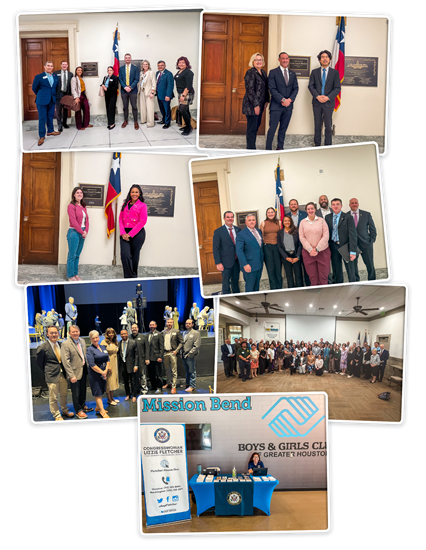
In Washington, Team TX-07 held nearly two dozen meetings with constituents and groups advocating on their behalf, including the Pasadena Chamber of Commerce, the Texas A&M Bush School, the Breast Cancer Alliance, and Economic Alliance Houston Port Region, pictured below. Back home in the district, our team was out and about across the district, helping constituents and attending community events, including the State of the City of Sugar Land, the Fort Bend ISD Teacher of the Year Reception, and a Constituent Services Pop-Up at the Mission Bend Boys & Girls Club, pictured below. |
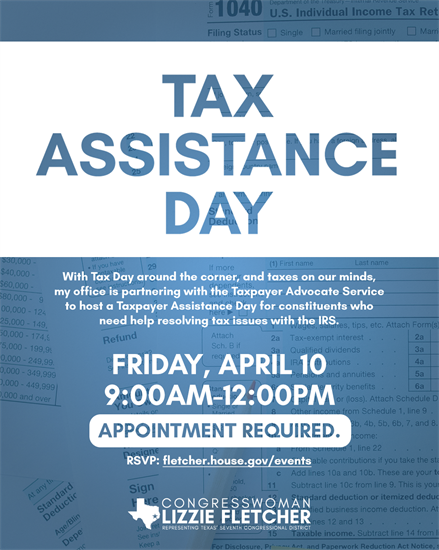
With Tax Day around the corner, and taxes on our minds, my office is partnering with the Taxpayer Advocate Service to host a Taxpayer Assistance Day for constituents who need help resolving tax issues with the IRS. Sign up here to join us on Friday, April 10. |
Submissions are due for the 2026 TX-07 Congressional Art Competition! This is a great opportunity for high school student artists who live in TX-07 to compete to have their art displayed in the U.S. Capitol. Submissions are due next Tuesday, March 31. Find more details and how to submit your art here or by clicking the image below. |
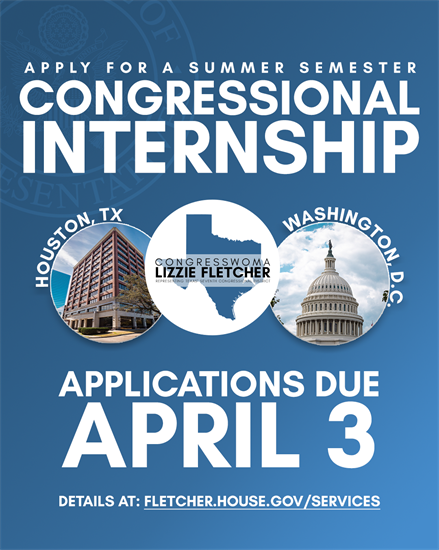
There is still time for students to apply for a summer internship in one of my offices! Applications are due next Friday, April 3, 2026 at 11:00pm CT. Learn more about the opportunity by clicking here or below. |
The House has now adjourned for the week, but what it will do next is not yet clear. As always, I will keep you posted on what happens next.
I am proud to represent you and I am here to help you. Please call my office at (713) 353-8680 or (202) 225-2571 or email here at any time to ask for assistance or share your thoughts. I look forward to hearing from you.
Best wishes, |
|